
Capriccio of Classical Ruins on a Shore
1751 to 1775
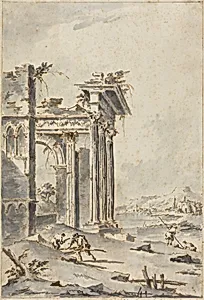
Medium
pen and black and brown ink with gray and brown wash on laid paper
Dimensions
overall (approximate): 52.2 x 35.2 cm (20 9/16 x 13 7/8 in.)
Classification
Drawing
Department
CG-E
Museum
National Gallery of Art, Washington, D.C.
Credit
Gift of Howard Sturges
Accession Number
1956.9.18
Rights
Public Domain
Art Historical Context
Step into the whimsical world of *Capriccio of Classical Ruins on a Shore*, a captivating drawing by Venetian artist Giacomo Guardi, created between 1751 and 1775. This intricate work on laid paper measures about 52 x 35 cm and depicts an imaginative composition of ancient ruins dramatically perched along a shoreline. Guardi, part of the esteemed Guardi family of painters, masterfully blends real architectural elements with fantasy, evoking the grandeur of antiquity against a serene seascape—a hallmark of the *capriccio* genre. Rendered in pen with black and brown ink, enhanced by subtle gray and brown washes, the piece showcases Guardi's skillful use of line and tone to build depth and atmosphere. The washes soften edges and suggest misty light, drawing viewers into a dreamlike reverie. Such techniques were prized in 18th-century Venice, where drawings like this served as both studies and collectible souvenirs for Grand Tour travelers captivated by classical heritage. Housed in the National Gallery of Art's CG-E Department as a gift from Howard Sturges, this drawing highlights the enduring appeal of Venetian landscape traditions. It invites us to ponder the interplay of memory, myth, and nature, bridging art historical movements like vedutismo with personal imagination.
About the Artist
Giacomo Guardi · 1764–1835
Giacomo Guardi (1764–1835) was a Venetian painter who worked in the long shadow of his celebrated father, Francesco Guardi, one of the greatest vedutisti — view painters — of the eighteenth century. Born into one of Venice's most prominent artistic families, Giacomo received his training directly from his father, absorbing both the technical methods and the characteristic style that had made Franc...