
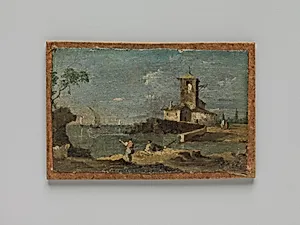
Capriccio with a Square Tower and Two Houses
18th century
Medium
Oil on paper, laid down on Masonite
Dimensions
2 1/4 x 3 3/8 in. (5.7 x 8.6 cm)
Classification
Paintings
Culture
Italian
Department
Robert Lehman Collection
Museum
Metropolitan Museum of Art, New York, NY
Credit
Robert Lehman Collection, 1975
Accession Number
1975.1.93
Rights
Public Domain
Tags
Art Historical Context
Francesco Guardi's *Capriccio with a Square and Two Houses* is delightful example of 18th-century painting, capturing the artist's imaginative flair for architectural fantasies. Guardi (1712–1793), a master of *veduta* tradition alongside Canaletto, specialized in *capricci*—whimsical compositions blending real landmarks with invented elements. Here, a sturdy square tower rises prominently amid two quaint houses, evoking the romantic decay and luminosity of Venice's canalside scenes, though rendered as a compact landscape study. Painted in oil on paper and later laid down on Masonite, this tiny gem measures just 2¼ x 3⅜ inches, suggesting it was a quick *bozzetto* (preparatory sketch) or personal exercise. Guardi's loose, atmospheric brushwork—hallmarks of his late Rococo style—creates a hazy, dreamlike quality, prioritizing mood over precise detail. This medium allowed for spontaneity, contrasting with larger canvas works commissioned by Grand Tour travelers. Now in the Robert Lehman Collection at The Metropolitan Museum of Art since 1975, this intimate piece highlights Guardi's role in preserving Venice's allure during a fading republic. It invites visitors to ponder how such small-scale visions fueled the city's enduring mythos in European art.
About the Artist
Francesco Guardi · 1712–1793
Francesco Lazzaro Guardi (1712–1793) was born into a noble family of painters from Trentino who had settled in Venice. His father, Domenico Guardi, a minor painter trained in Vienna, died in 1716, leaving young Francesco to inherit the family workshop alongside his brothers Giovanni Antonio (Gian Antonio) and Niccolò, both artists, and sister Maria Cecilia, who married the renowned Giovanni Battis...