
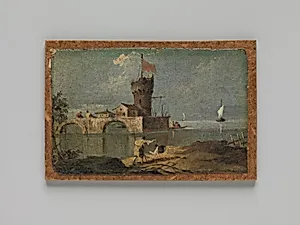
Capriccio with a Circular Tower, Two Houses, and a Bridge
18th century
Medium
Oil on paper, laid down on Masonite
Dimensions
2 1/8 x 3 1/2 in. (5.4 x 8.9 cm)
Classification
Paintings
Culture
Italian
Department
Robert Lehman Collection
Museum
Metropolitan Museum of Art, New York, NY
Credit
Robert Lehman Collection, 1975
Accession Number
1975.1.92
Rights
Public Domain
Tags
Art Historical Context
Francesco Guardi's *Capriccio with a Circular, Two Houses, and Bridge* (18th century) captures the whimsical essence of Venetian fantasy architecture in a remarkably intimate scale. This oil on paper, laid down on Masonite, just 2 1/8 x 3 1/2 inches, depicting a dreamlike vista with a striking circular tower, quaint houses, a graceful bridge, and hints of boats below. Guardi, a leading figure in 18th-century Venice alongside Canaletto, specialized in *vedute*—topographical views—and *capricci*, imaginative compositions blending real landmarks with invented elements to evoke the city's magical allure. Guardi's loose, atmospheric brushwork infuses the scene with luminosity and movement, distinguishing his style from the more precise linearity of his predecessors. The unusual choice of paper as a support suggests this may be a preparatory sketch or *bozzetto*, showcasing his spontaneous technique and mastery of light on water—a hallmark of Venetian painting that foreshadowed Impressionism. Such small-scale works highlight the artist's versatility beyond grand canvases. Housed in the Metropolitan Museum of Art's Robert Lehman Collection since 1975, this gem invites visitors to ponder Venice's blend of reality and reverie, where towers and bridges symbolize the Republic's enduring grandeur amid the lagoon's ebb and flow.
About the Artist
Francesco Guardi · 1712–1793
Francesco Lazzaro Guardi (1712–1793) was born into a noble family of painters from Trentino who had settled in Venice. His father, Domenico Guardi, a minor painter trained in Vienna, died in 1716, leaving young Francesco to inherit the family workshop alongside his brothers Giovanni Antonio (Gian Antonio) and Niccolò, both artists, and sister Maria Cecilia, who married the renowned Giovanni Battis...