
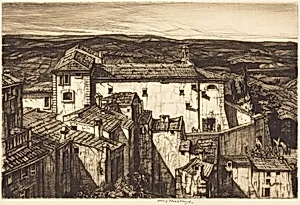
Carceri San Gimignano
1925
Medium
drypoint in black
Dimensions
plate: 16.5 × 25 cm (6 1/2 × 9 13/16 in.)
Classification
Department
CG-W
Museum
National Gallery of Art, Washington, D.C.
Credit
Rosenwald Collection
Accession Number
1943.3.7525
Rights
Public Domain
Art Historical Context
Henry Rushbury's *Carceri San Gimignano* (1925) invites visitors to the National Gallery of Art into the shadowy world of San Gimignano's historic prisons. This evocative drypoint print, from the renowned Rosenwald Collection, depicts the imposing stone structures of the medieval Tuscan hill town, famous for its towering skyline. Created just after World War I, the work reflects Rushbury's fascination with European architecture, rendered with a British printmaker's precise eye for texture and atmosphere. Drypoint, the medium here, is a direct intaglio technique where the artist scratches lines into a copper plate, raising a soft burr that holds ink for rich, velvety blacks. At 16.5 × 25 cm, this intimate plate size enhances the print's tactile intensity, allowing intricate details of weathered walls and arched doorways to emerge with haunting depth—distinct from smoother etching lines. As a classified print in the CG-W department, *Carceri* exemplifies early 20th-century topographical artistry, blending historical reverence with modern graphic boldness. Pause before it to imagine the echoes of past incarcerations in San Gimignano's timeless streets.
About the Artist
Henry Rushbury · 1889–1968
Henry Rushbury was a British artist celebrated primarily for his etchings and watercolors of architectural subjects, working during the early and middle decades of the twentieth century. He studied at the Birmingham School of Art before moving to London, where he became part of a generation of printmakers who revitalized the etching medium in Britain during the years surrounding the First World Wa...