
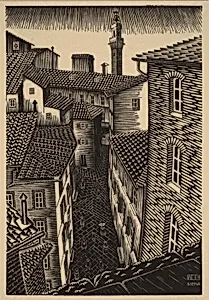
Siena
1922
Medium
woodcut
Dimensions
image: 32 x 21.6 cm (12 5/8 x 8 1/2 in.)
Classification
Department
CG-W
Museum
National Gallery of Art, Washington, D.C.
Credit
Seymour and Iris Schwartz Collection
Accession Number
1983.110.4
Rights
Public Domain
Art Historical Context
In 1922, Dutch artist M.C. Escher *Siena*, a striking woodcut measuring 32 x 21.6 cm, now housed in the National Gallery of's Seymour and Iris Schwartz. This early print captures the timeless charm of Siena, the historic Tuscan hill town famed for its medieval architecture, winding streets, and iconic Gothic cathedral. Escher, then in his early twenties, was honing his craft during travels through Italy, producing a series meticulous landscapes that blend observation with technical precision. Woodcuts like this one highlight Escher's mastery of the relief printing technique, where intricate designs are carved into wood blocks, inked, and pressed onto paper. The medium allows for bold contrasts and fine lines, rendering Siena's rooftops, towers, and distant hills with remarkable clarity and depth. Unlike his later mind-bending tessellations and impossible architectures, this work reflects his representational phase, influenced by the Italian countryside's dramatic vistas. *Siena* offers a window into Escher's formative years, showcasing his emerging talent for capturing spatial complexity—a precursor to his mathematical genius. Visitors will appreciate its evocative portrayal of Italy's cultural heritage, inviting a sense of wanderlust amid the gallery's quiet halls.
About the Artist
M.C. Escher · 1898–1972
Maurits Cornelis Escher (1898-1972) was a Dutch graphic artist renowned for his mathematically-inspired woodcuts, lithographs, and mezzotints featuring impossible constructions, tessellations, and explorations of infinity. Though he considered himself lacking in mathematical ability, Escher's work demonstrates profound intuitive understanding of geometry, symmetry, and spatial paradox. A transform...