
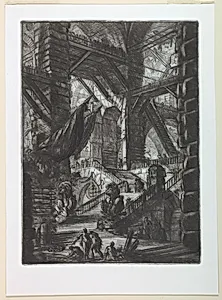
Carceri Series, Plate VIII
Classification
Department
Smithsonian Collection
Museum
Smithsonian American Art Museum
Credit
Gift of Gertrude W. Lewis
Accession Number
1959-182-7
Rights
Public Domain
About this artwork
Research in Progress
Art Historical Context
Giovanni Battista Piranesi, a visionary Italian artist and architect (1720–1778), created his iconic *Carceri d'Invenzione* (Imag Prisons) series around 1745, with Plate VIII as one of the most evocative entries. These prints, produced during the Enlightenment era in Venice and Rome, transport viewers into vast, labyrinthine underground dungeons filled with towering arches, endless staircases, and shadowy machinery. Piranesi's etching technique—though the exact medium here remains under study—allowed for intricate details and dramatic contrasts of light and shadow, blurring the line between architecture and fantasy. Artistically, the *Carceri* series exemplifies Piranesi's neoclassical roots infused with proto-Romantic intensity, challenging viewers' sense of scale and reality. They reflect 18th-century fascination with antiquity and ruins, while evoking psychological themes of confinement and the sublime. As a print from the Smithsonian American Art Museum's collection, gifted by Gertrude W. Lewis, this work highlights Piranesi's enduring influence on later artists like M.C. Escher and the Surrealists. Though research continues, Plate VIII captivates with its boundless vistas, inviting museum-goers to ponder the human imagination's architectural dreams—and nightmares.