
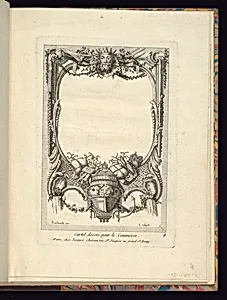
Cartel décoré pour le Commerce
Classification
Department
Smithsonian Collection
Museum
Smithsonian American Art Museum
Credit
Purchased for the Museum by the Advisory Council
Accession Number
1921-6-239-4
Rights
Public Domain
About this artwork
Research in Progress
Art Historical Context
**Cartel Décoré pour le Commerce** *Pierre-Gabriel Berth (French, 1737–1831), ca.1758* *Print; Smithsonian American Art Museum* around 1758 by French engraver Pierre-Gabriel Berthault *Cartel Décoré pour Commerce*—or "Decorated Cartel Commerce"—is a charming print showcasing the ornate decorative arts of mid-18th-century France Berthault, renowned for his intricate engravings of architecture and ornamental designs, captures a "cartel," a lavish wall-mounted plaque or clock frame, themed around commerce. This reflects the era's fascination with trade and prosperity, symbolized through elegant motifs amid the exuberant Rococo style, with its flowing curves, shells, and gilded flourishes. As a print, the work served a practical purpose: disseminating sophisticated designs to artisans, architects, and collectors across Europe. Prints like this were vital in the Age of Enlightenment, bridging fine art and everyday luxury, influencing furniture makers and interior decorators. Though the exact medium remains under study, its classification highlights the technical precision of engraving, allowing detailed reproduction of opulent patterns. Housed in the Smithsonian American Art Museum, purchased by the Advisory Council, this piece underscores transatlantic appreciation for French elegance. Ongoing research promises deeper insights, but it already invites visitors to envision bustling 18th-century salons alive with symbols of commerce and craftsmanship. (198 words)