
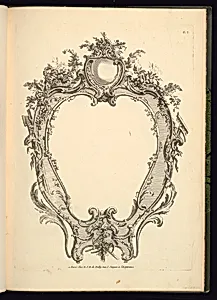
Cartouche Design
mid- 18th century
Classification
Department
Smithsonian Collection
Museum
Smithsonian American Art Museum
Credit
Purchased for the Museum by the Advisory Council
Accession Number
1921-6-328-13
Rights
Public Domain
About this artwork
Research in Progress
Art Historical Context
**Cartouche Design** by Nicolas-Jean-Baptiste Poilly (French, 1707–1780) captures the ornate elegance of mid-18th-century French decorative arts. Poilly, a skilled engraver, specialized in intricate prints that adorned books, maps, and architectural elements. A cartouche—a scrolling, ornamental frame often featuring foliage, shells, or mythical motifs—served as a decorative enclosure for titles, coats of arms, or illustrations, embodying the playful exuberance of the Rococo style prevalent in Louis XV-era France. As a print from the Smithsonian American Art Museum's collection, this work highlights the technical mastery of engraving, where fine lines and textures create depth and movement on paper. Though the exact medium awaits further research, such prints were vital for disseminating designs across Europe and the Americas, influencing furniture, silverwork, and even early American architecture. Poilly's piece reflects how these whimsical frames bridged fine art and everyday ornamentation. Purchased for the museum by the Advisory Council, *Cartouche Design* invites us to appreciate the artistry behind the decorative details that shaped 18th-century visual culture. Ongoing research promises to reveal more about its creation and impact—stay tuned!