
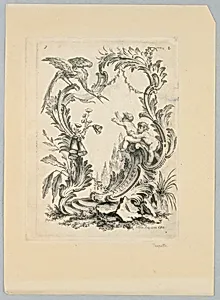
Cartouche with Bird and Putti, Plate B
Medium
Classification
Department
Smithsonian Collection
Museum
Smithsonian American Art Museum
Credit
Gift of Eleanor and Sarah Hewitt
Accession Number
1931-94-644
Rights
Public Domain
About this artwork
Research in Progress
Art Historical Context
Created around 1740 by French artist Alexis Peyrotte, *Cartouche with Bird and Putti, Plate B* exemplifies the playful elegance of the Rococo period. Peyrotte, active during the reign of Louis XV, specialized in ornamental designs that blended delicate natural motifs with fanciful figures. This print features a decorative cartouche—a framed, scroll-like form—surrounded by a bird and putti, the cherubic figures often used to evoke lightness and charm in 18th-century decoration. As a print, the work likely served as a model or pattern for artisans working in textiles, ceramics, or architecture. Such designs circulated widely across Europe, allowing the Rococo taste for asymmetry, curves, and nature-inspired details to reach a broad audience beyond the royal court. The Smithsonian American Art Museum’s impression was generously donated by Eleanor and Sarah Hewitt, noted collectors whose gifts helped build the museum’s holdings of European decorative arts. Though research on this specific plate continues, it offers visitors a glimpse into how printed ornament shaped the visual world of the Enlightenment era.