
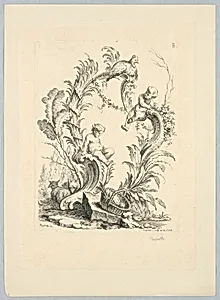
Scrollwork and Vegetal Cartouche in Landscape, Plate B
Medium
Classification
Department
Smithsonian Collection
Museum
Smithsonian American Art Museum
Credit
Gift of Eleanor and Sarah Hewitt
Accession Number
1931-94-640
Rights
Public Domain
About this artwork
Research in Progress
Art Historical Context
Alexis Peyrotte’s “Scrollwork and Vegetal Cartouche in Landscape, Plate B” captures the playful elegance of eighteenth-century French design. Created around 1740 as a print, the work presents an ornate cartouche framed by curling scrolls and leafy motifs set within a gently suggested landscape. Such plates were typically produced as part of ornamental series intended to inspire decorators, silversmiths, and textile designers rather than to stand alone as finished pictures. Peyrotte, active during the height of the Rococo period, specialized in these lighthearted, nature-inspired patterns that favored asymmetry and delicate detail over rigid symmetry. The print medium allowed his inventive compositions to circulate widely among craftsmen across Europe, helping spread the goût pittoresque—the picturesque taste—that defined French interiors of the 1740s. Now part of the Smithsonian American Art Museum’s collection through the generosity of Eleanor and Sarah Hewitt, the sheet offers today’s visitors a glimpse into how decorative ideas traveled from artist’s studio to everyday objects in the Age of Enlightenment.