
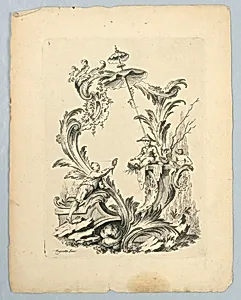
Cartouche with Chinoiserie Motifs
Classification
Department
Smithsonian Collection
Museum
Smithsonian American Art Museum
Credit
Gift of Eleanor and Sarah Hewitt
Accession Number
1931-94-665
Rights
Public Domain
About this artwork
Research in Progress
Art Historical Context
Alexis Peyrotte’s *Cartouche with Chinoiserie Motifs*, created around 1740, captures the playful elegance of French Rococo design. As a print, it showcases a decorative cartouche—an ornamental frame—filled with whimsical Asian-inspired elements such as pagodas, exotic birds, and delicate foliage. Peyrotte, noted French designer and draftsman, specialized in ornamental patterns that influenced furniture, textiles, and interior decoration during the reign of Louis XV. This work reflects the widespread European fascination with chinoiserie, a style that blended imagined Chinese and Japanese aesthetics with Western tastes. In the mid-eighteenth century, such motifs symbolized luxury and worldly curiosity, often appearing in aristocratic homes as a lighter alternative to formal Baroque grandeur. Though the exact printing technique remains under study, the piece exemplifies how prints served as accessible pattern books for artisans across Europe. Housed in the Smithsonian American Art Museum through the generous gift of Eleanor and Sarah Hewitt, the print offers today’s visitors a glimpse into the cross-cultural exchanges that shaped decorative arts of the period. Its refined lines and imaginative details continue to charm, reminding us of an era when art celebrated both fantasy and craftsmanship.