
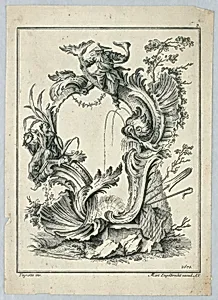
Cartouche with Chinoiserie Motifs
Medium
Classification
Department
Smithsonian Collection
Museum
Smithsonian American Art Museum
Credit
Gift of Eleanor and Sarah Hewitt
Accession Number
1931-94-653
Rights
Public Domain
About this artwork
Research in Progress
Art Historical Context
This elegant print by French designer Alexis Peyrotte captures the playful spirit of eighteenth-century chinoiserie, a decorative style that blended European forms with imagined Asian motifs. Created around 1740, the work features a cartouche—an ornamental frame—adorned with delicate pagodas, exotic birds, and scrolling foliage that evoke an idealized vision of China popular among French elites during the Rococo period. Peyrotte, active in Paris and later at the Gobelins tapestry manufactory, specialized in such ornamental designs that influenced furniture, textiles, and interiors across Europe. As a print, this piece served both as an artwork and a practical design source, allowing artisans to replicate its motifs in other media. Its presence in the Smithsonian American Art Museum collection, gifted by Eleanor and Sarah Hewitt, highlights how these patterns traveled across the Atlantic and shaped American decorative tastes. Though research on this specific example remains ongoing, it exemplifies the era’s fascination with cross-cultural exchange and the Rococo love of asymmetry and whimsy.