
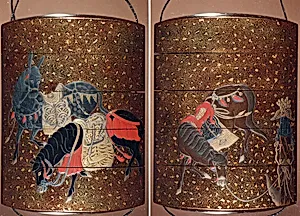
Case (Inrō) with Design of Two Saddled Horses (obverse); Saddled Mule beside Decorated Post (reverse)
Unknown Artist
18th–19th century
Medium
Lacquer, nashiji, hirame, gold and coloured hiramakie, takamakie; Interior: nashiji, fundame & red lacquer
Dimensions
3 3/8 x 2 3/8 x 7/8 in. (8.5 x 6.1 x 2.2 cm)
Classification
Inrō
Culture & Period
Japan · Edo period (1615–1868)
Department
Asian Art
Museum
Metropolitan Museum of Art, New York, NY
Credit
H. O. Havemeyer Collection, Bequest of Mrs. H. O. Havemeyer, 1929
Accession Number
29.100.895
Rights
Public Domain
Tags
Art Historical Context
This exquisite *inrō*, a compact lacquered case from Japan's Edo period (1615–1868), dates to the 18th–19th and measures just 3⅜ × 2⅜ × ⅞ inches. Worn suspended from a belt by a silk cord (secured by a netsuke), served as a portable container for medicines, seals, or inks—essential for men in kimonos lacking pockets. The obverse features two finely saddled horses, symbols of strength and nobility, while the reverse a saddled mule beside an ornate post, evoking travel and equestrian elegance. Crafted by an unknown master, the piece showcases virtuoso lacquer techniques central to Japanese art. The exterior gleams with *nashiji* (pearlescent gold flecks) and *hirame* grounds, overlaid with *hiramakie* (flat gold designs) and *takamakie* (raised motifs) in gold and colors for vivid depth. Inside, *nashiji*, *fundame* (metallic base), and red lacquer add luxurious contrast. These methods, refined over centuries, highlight Edo-era artisans' precision and the status inrō conferred on owners. Part of the Metropolitan Museum of Art's H. O. Havemeyer Collection (bequest 1929), this inrō reflects the period's opulent craftsmanship, blending utility with artistry in Asian Art traditions. A delightful glimpse into daily samurai life!