
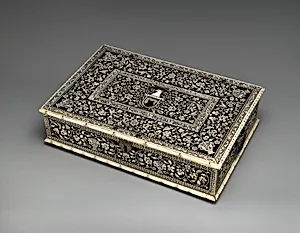
Casket
Unknown Artist
ca. 1760–65
Medium
Ebony and engraved ivory, tortoiseshell; mirror glass; silver hardware; brass feet; iron lock
Dimensions
Overall (confirmed): 5 1/4 × 20 5/8 × 14 in. (13.3 × 52.4 × 35.6 cm)
Classification
Natural Substances-Ivory
Culture
Indian, Vizagapatam
Department
European Sculpture and Decorative Arts
Museum
Metropolitan Museum of Art, New York, NY
Credit
Purchase, The James Parker Charitable Foundation Gift, 2016
Accession Number
2016.115
Rights
Public Domain
Art Historical Context
This exquisite casket, crafted around 1760–65 in Vizagapatam (modern-day Visakhapatnam, India), exemplifies the region's renowned workshops that produced luxurious decorative objects for European export. Measuring a compact 5¼ × 20⅝ × 14 inches, it features a sturdy ebony frame inlaid with finely engraved ivory, shimmering tortoiseshell, and mirror glass, accented by silver hardware, brass feet, and an iron lock. These materials highlight the masterful blend of local resources—ebony from India's forests and ivory from its wildlife—with imported European fittings, creating a portable treasure chest fit for a gentleman's dressing table or a lady's vanity. Hailing from the peak of Vizagapatam production during British colonial trade, this casket reflects intense cultural exchange between Indian artisans and Western tastes. Workshops there specialized in opulent, Baroque-inspired pieces that catered to Europe's fascination with exotic "Indian" luxury, often rivaling the finest European cabinetry. The engraved ivory technique, involving delicate incisions filled with pigments, demanded exceptional skill, turning natural substances into storytelling surfaces—likely adorned with floral motifs or figural scenes evoking fantasy and abundance. Today, housed in The Metropolitan Museum of Art's European Sculpture and Decorative Arts department, this casket invites us to ponder the global threads of craftsmanship and commerce in the 18th century, a testament to anonymous Indian artists whose ingenuity bridged continents.