
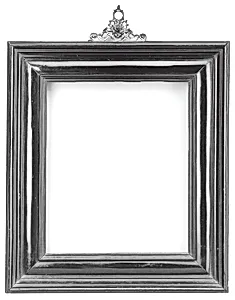
Cassetta frame
Unknown Artist
late 19th century, style mid-16th century
Medium
Poplar half-lapped back frame with applied ebony and ebonized pearwood upper moldings.
Dimensions
Overall: 17 1/8 × 15 3/16 in. (43.5 × 38.5 cm) Sight: 11 13/16 × 9 3/4 in. (30 × 24.7 cm) Rabbet: 12 3/16 × 10 1/4 in. (31 × 26 cm)
Classification
Frames
Culture
Italian, Veneto
Department
Robert Lehman Collection
Museum
Metropolitan Museum of Art, New York, NY
Credit
Robert Lehman Collection, 1975
Accession Number
1975.1.2300
Rights
Public Domain
Art Historical Context
This exquisite Cassetta frame, hailing from Italy's Veneto region, exemplifies a late 19th-century revival mid-16th-century style. Cassetta frames, meaning "little box" in Italian, originated in Venice during the High Renaissance, designed as self-contained architectural panels that framed paintings like precious jewels. Though crafted around 1900 by an unknown artisan, its classical proportions and bold moldings evoke the opulent workshops of 16th-century Venice, where frames were integral to a painting's presentation, enhancing its narrative and status. Constructed from poplar with a half-lapped back for sturdy structural integrity, the frame features applied ebony moldings for rich contrast and ebonized pearwood on the upper sections, mimicking the luxurious dark tones prized in Renaissance interiors. Measuring 17 1/8 × 15 3/16 inches overall, with a sight size of about 12 × 10 inches, it was tailored for a modest portrait or devotional panel, underscoring the period's precision in woodworking. Now part of the Robert Lehman Collection at The Metropolitan Museum of Art (acquired 1975), this frame highlights the enduring allure of Venetian design traditions. It reminds us that frames were not mere supports but artistic partners, transforming paintings into conversation pieces in grand palazzi. A testament to 19th-century historicism, it bridges eras with timeless elegance.