
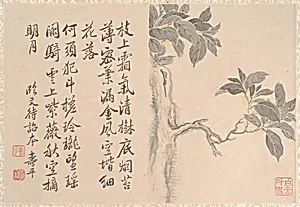
清 仿惲壽平 桂花圖 冊頁|Cassia Tree
Medium
Album leaf; ink and color on paper
Dimensions
8 1/8 x 12 in. (20.6 x 30.5 cm)
Classification
Paintings
Culture & Period
China · Qing dynasty (1644–1911)
Department
Asian Art
Museum
Metropolitan Museum of Art, New York, NY
Credit
Bequest of John M. Crawford Jr., 1988
Accession Number
1989.363.145
Rights
Public Domain
Tags
Art Historical Context
This delicate album leaf, titled *Cassia Tree*, emulates the masterful style of Yun Shouping (16331690), a leading Qing dynasty painter renowned for his elegant flower-and-bird compositions. Created by an unidentified artist during the Qing period (1644–1911), it captures the graceful branches and blossoms of the cassia (osmanthus) tree using ink and color on paper. Measuring just 8⅛ × 12 inches, this intimate format was prized in China for private contemplation, often collected in albums by scholars and collectors. Yun Shouping's shines through in the work's refined technique, likely employing the "boneless" method—soft washes of color without hard outlines—to evoke the cassia's luminous autumn blooms. In Chinese culture, the cassia tree holds deep symbolism, associated with immortality, the moon festival, and poetic themes of longing and renewal, making it a favorite motif in literati painting. Housed in the Metropolitan Museum of Art's Asian Art collection through the bequest of John M. Crawford Jr., this piece exemplifies Qing artistic reverence for Ming-Qing masters, blending technical virtuosity with cultural resonance for enduring appeal.
About the Artist
Yun Shouping|Unidentified artist · 1633–1690
Yun Shouping originally had the name Ge and the style name Shouping, by which he later went. A native of Wujin in Jiangsu, he at first excelled at landscape painting but later felt that he could not compete with the master Wang Hui (1632-1717), turning to flowers instead. His style can be traced all the way back to the "boneless" method of washes used by Xu Chongsi (fl. latter half of 10th c.), bu...