
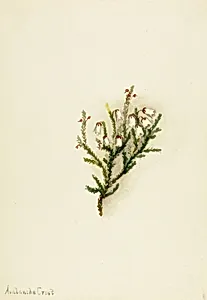
Cassiope (Cassiope mertensiana)
ca. 1900-1905
Medium
Painting
Classification
Painting
Department
Smithsonian Collection
Museum
Smithsonian American Art Museum
Credit
Smithsonian American Art Museum, Gift of the artist
Accession Number
1970.355.109
Rights
Public Domain
Tags
Art Historical Context
Mary Vaux Walcott'sCassiope (Cassiopeensiana)*, created 1900-1905, is a painting from the Smithsonian American Art Museum's collection, generously gifted by the artist herself. This delicate work depicts the Cassiope mertensiana, resilient alpine wildflower also known as Mertens' cassiope, with its clusters of small, bell-shaped white blooms nodding amid evergreen foliage. Walcott, a pioneering self-taught artist and botanist, captured these high-mountain beauties during her expeditions in the Canadian Rockies, blending artistic finesse with scientific precision. As a Quaker mountaineer and wife of Smithsonian Secretary Charles Doolittle Walcott, Mary Vaux Walcott produced over 1,000 watercolor paintings of North American flora between 1899 and 1912, many reproduced in her acclaimed book *North American Wild Flowers* (1924). Her works hold historical significance as both aesthetic treasures and vital botanical records, bridging art and science at a time when women were rarely credited in such fields. This painting exemplifies her meticulous technique—likely in watercolor—rendering petals, stems, and habitats with lifelike detail that aids identification even today. Visitors, marvel at how Walcott's brush immortalized fragile mountain life, inviting us to appreciate nature's tenacity through her enduring legacy.