
Cassone
Unknown Artist
ca. 1550–80 (rebuilt, with later additions)
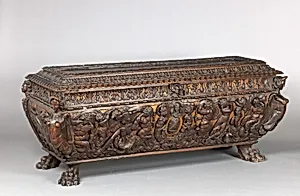
Medium
Walnut, carved and partially gilded.
Dimensions
H. 70.5 cm, W. 149.8 cm, D. 45.7 cm.
Classification
Woodwork-Furniture
Culture
Italian (Tuscany or Rome?)
Department
Robert Lehman Collection
Museum
Metropolitan Museum of Art, New York, NY
Credit
Robert Lehman Collection, 1975
Accession Number
1975.1.1939
Rights
Public Domain
Art Historical Context
Step into the opulent world of Renaissance Italy this striking *cassone*, a lavish marriage chest crafted around 1550–80, possibly in Tuscany or Rome. Measuring about 70 cm high and 150 cm wide, this walnut woodwork exemplifies the grandeur of period furniture, designed not just for storage but as a symbol of wealth and marital alliance. Cassoni like this were often given as dowry gifts, their exteriors carved with intricate scenes to celebrate love, virtue, or classical tales, making them both functional heirlooms and artistic statements. The chest's medium—finely carved walnut with partial gilding—highlights masterful Renaissance woodworking techniques. Walnut's rich grain allowed for detailed relief carvings, while gold leaf accents evoked the splendor of elite homes. Though rebuilt with later additions, it retains the era's stylistic flair, blending robustness with elegance. Housed in the Metropolitan Museum of Art's Robert Lehman Collection since 1975, this piece offers a tangible link to 16th-century domestic life, where furniture doubled as storytelling canvases for the newlywed elite. (198 words)