
Cassone (chest), pair with 1975.1.1940
Unknown Artist
mid-16th century (with 19th-century additions)
Medium
Walnut, carved and partially gilded; coniferous wood.
Dimensions
Height: 34 1/2 in. (87.6 cm) Width: 24 in. (61 cm) Length: 66 15/16 in. (170 cm)
Classification
Woodwork-Furniture
Culture
Italian (Rome or Siena?)
Department
Robert Lehman Collection
Museum
Metropolitan Museum of Art, New York, NY
Credit
Robert Lehman Collection, 1975
Accession Number
1975.1.1947
Rights
Public Domain
Tags
Art Historical Context
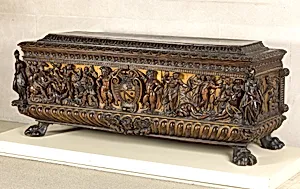
This elegant cassone, or marriage chest, from mid-16th-century Italy (likely Rome or Siena), exemplifies furniture craftsmanship as part of the Robert Lehman Collection the Metropolitan Museum of Art Paired with its mate (1975.1.1940), it served as a dowry chest for storing a bride's linens and garments, blending practicality with opulent display. Crafted from richly carved walnut—partially gilded for a luxurious sheen—and reinforced with coniferous wood, it measures an impressive 66 15/16 inches long, standing 34 1/2 inches tall. The chest's surface bursts with dynamic high-relief carvings depicting male nudes, spirited horses, and robust male figures, framed by a prominent coat of arms that likely signified a noble family's heritage. These motifs evoke classical antiquity, a hallmark of Renaissance art, celebrating strength, virility, and equestrian prowess while showcasing the woodcarver's mastery of anatomy and movement. Subtle 19th-century additions reflect later restorations, preserving its grandeur. As a survivor of domestic life, this cassone offers a window into Italian elite culture, where furniture doubled as status symbols and storytelling canvases, bridging utility and artistic ambition in walnut's warm, enduring grain.