
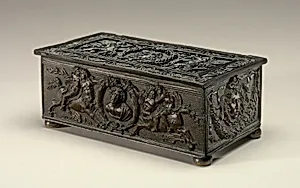
Writing Casket
c. 1500
Medium
bronze
Dimensions
overall: 7.8 x 20.3 x 12 cm (3 1/16 x 8 x 4 3/4 in.)
Classification
Sculpture
Department
CSD
Museum
National Gallery of Art, Washington, D.C.
Credit
Samuel H. Kress Collection
Accession Number
1957.14.61
Rights
Public Domain
Art Historical Context
Nestled in the National Gallery of Art's Samuel H. Kress Collection, this exquisite *Writing Casket* hails from Padua in the early 16th century, around 1500. Crafted in bronze, this compact sculpture measures just 7.8 x 20.3 x 12 cm, embodying the Renaissance mastery of small-scale metalwork from northern Italy. Padua was a vibrant hub for bronze artists, where workshops produced intricate luxury objects blending classical antiquity with contemporary ingenuity. The casket's bronze medium highlights advanced lost-wax casting techniques, allowing for fine detailing on its surfaces—likely adorned with reliefs of mythological figures, grotesques, or humanistic motifs typical of Paduan style. These writing boxes were not mere containers for inkwells, quills, and wax tablets but status symbols for scholars and gentlemen, reflecting the era's revival of learning and the humanist ideal of the educated elite. As a functional yet artistic treasure, it captures the Renaissance fusion of utility and beauty, inviting us to imagine a Renaissance scribe opening its lid amid candlelight. Its survival speaks to the enduring allure of Paduan bronzes, prized for their tactile warmth and narrative depth. (198 words)