
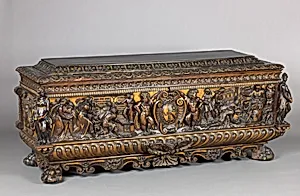
Cassone (chest), pair with 1975.1.1947
Unknown Artist
mid-16th century (with 19th century additions)
Medium
Walnut, carved and partially gilded; coniferous wood.
Dimensions
H. 73.6 cm, W. 1.7 m, D. 63.5 cm
Classification
Woodwork-Furniture
Culture
Italian (Rome or Siena?)
Department
Robert Lehman Collection
Museum
Metropolitan Museum of Art, New York, NY
Credit
Robert Lehman Collection, 1975
Accession Number
1975.1.1940
Rights
Public Domain
Tags
Art Historical Context
This elegant cassone, or marriage chest, hails from mid-16th-century Italy—likely Rome or Siena—and forms a pair with its counterpart (1975.1.1947) in the Robert Lehman Collection the Metropolitan Museum of Art Cassoni like this were prized furnishings in Renaissance households, often commissioned as wedding gifts to store linens and dowry goods. Their carved fronts served as public displays of family prestige, blending utility with opulent storytelling through intricate reliefs. Crafted from richly grained walnut, the chest is masterfully carved and partially gilded for a luxurious sheen, with coniferous wood possibly used for structural elements or panels. Standing 73.6 cm high, 1.7 m wide, and 63.5 cm deep, it features lively motifs of men, playful putti (cherubic figures symbolizing love and fertility), and a prominent coat of arms—hallmarks of Italian Renaissance woodwork that celebrated marital unions and noble lineages. Subtle 19th-century additions reflect later restorations, preserving its grandeur. As a testament to Italy's woodworking mastery, this piece illuminates the era's fusion of function, heraldry, and humanism, inviting us to imagine Renaissance brides unpacking treasures within its ornate embrace. (198 words)