
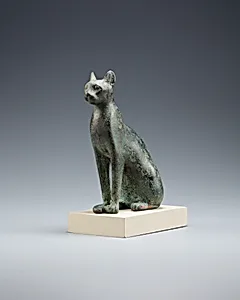
Cat
Unknown Artist
664–30 B.C.
Medium
Cupreous metal
Dimensions
H. 13.7 cm (5 3/8 in.); W. 5.6 cm (2 3/16 in.); L. 8.4 cm (3 5/16 in.) H. (with tang): 15 cm (5 7/8 in.)
Classification
Figurine, cat
Period
Late Period–Ptolemaic Period
Department
Egyptian Art
Museum
Metropolitan Museum of Art, New York, NY
Credit
Gift of Darius Ogden Mills, 1904
Accession Number
04.2.472
Rights
Public Domain
Tags
Art Historical Context
This delightful bronze cat figurine, crafted by an unknown Egyptian artist during the Late Period to Ptolemaic era (664–30 B.C.), captures the sacred allure of felines in ancient Egypt. just 13.7 cm tall (15 cm with its tang for mounting), the small sculpture—made from cupreous metal, an alloy primarily of copper—exemplifies the period's refined metalworking techniques. Its compact dimensions (W. 5.6 cm; L. 8.4 cm) suggest it was as a portable votive object, perfect for devotion or adornment. In Egyptian culture, cats symbolized protection, fertility, and the home, closely linked to the goddess Bastet, whose cult flourished at sites like Bubastis. Such figurines were commonly offered at temples as expressions of piety, blending everyday reverence with divine symbolism. The Ptolemaic Period, influenced by Greek rulers after Alexander the Great, saw a surge in these bronze votives, reflecting both continuity of pharaonic traditions and Hellenistic artistry. Today, this charming piece resides in the Metropolitan Museum of Art's Egyptian Art department, a 1904 gift from Darius Ogden Mills. It invites us to ponder the ancient Egyptians' deep bond with cats—guardians against evil and emblems of grace—still resonating in our cat-loving world.