
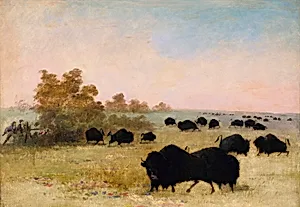
Catlin and Party Stalking Buffalo, Upper Missouri
1846-1848
Medium
Painting
Classification
Painting
Department
Smithsonian Collection
Museum
Smithsonian American Art Museum
Credit
Smithsonian American Art Museum, Gift of Mrs. Joseph Harrison, Jr.
Accession Number
1985.66.579
Rights
Public Domain
Tags
About this artwork
“Their colour is a dark brown, but changing very much as the season varies from warm to cold; their hair or fur, from its great length in the winter and spring, and exposure to the weather, turning quite light, and almost to a jet black, when the winter coat is shed off, and a new growth is shooting out.” (Catlin, Letters and Notes, vol. 1, no. 31, 1841; reprint 1973)
Art Historical Context
In this vivid painting from 1846–1848, George Catlin portrays himself and his companions stalking buffalo along the Upper Missouri River. The scene captures the tension of the hunt, with figures moving stealthily through the landscape as the massive animals graze nearby. As both artist and participant, Catlin includes a self-portrait, emphasizing his firsthand role in documenting the American West during a period of rapid change. Catlin, a pioneering painter of the frontier, traveled extensively through Native American territories in the 1830s to record vanishing wildlife and cultures. This work reflects his commitment to visual ethnography, blending adventure with careful observation. His accompanying notes describe the buffalo’s shifting coat—from dark brown in summer to lighter shades in winter—highlighting the animal’s adaptation to the harsh plains environment. The painting’s significance lies in its dual role as both artistic record and personal narrative. By placing himself within the action, Catlin invites viewers to experience the excitement and danger of Western exploration. Today it stands as a valuable window into mid-nineteenth-century encounters with the American landscape and its iconic wildlife.
About the Artist
George Catlin · 1796–1872
George Catlin (1796–1872), born in Wilkes-Barre, Pennsylvania, to Putnam Catlin and Polly Sutton—who had been captured by Native Americans during the 1778 Battle of Wyoming—initially pursued a legal career. Trained at Litchfield Law School, he was admitted to the bar in 1819 but abandoned law after two years to study art in Philadelphia in 1823. Self-taught as a portraitist, Catlin quickly gained ...