
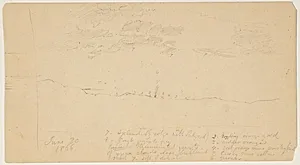
Catskill Sunset, Hudson, New York
June 30, 1866
Classification
landscapes
Department
Smithsonian Collection
Museum
Smithsonian American Art Museum
Credit
Gift of Louis P. Church
Accession Number
1917-4-1087
Rights
Public Domain
About this artwork
Research in Progress
Art Historical Context
Frederic Edwin Church, a master of the Hudson River School, captures the majestic beauty of his local landscape in *Catskill Sunset, Hudson New York* (1866). As a leading figure in this 19th-century American art, Church celebrated the sublime wilderness of the northeastern United States, drawing inspiration from the Hudson River Valley and Catskill Mountains near his home in Hudson, New York. Painted just after the Civil War, work reflects a era of national healing, where artists like Church used vivid natural scenes to evoke wonder, spirituality, and American identity. This landscape exemplifies Church's signature style: meticulous detail, dramatic lighting, and luminous atmospheric effects that transform everyday vistas into transcendent experiences. Though the medium is unknown, his typical oil paintings featured hyper-realistic rendering of foliage, water, and skies, often glowing with sunset hues to symbolize divine harmony. Dated precisely to June 30, 1866, it likely stems from on-site sketching during Church's plein air practice, blending scientific precision—influenced by his studies of nature—with romantic grandeur. Now in the Smithsonian American Art Museum as a gift from Louis P. Church, this piece invites visitors to ponder the enduring allure of the Catskills, a region immortalized by the Hudson River School. Research continues, promising deeper insights into Church's personal connection to this serene, golden-hour moment.