
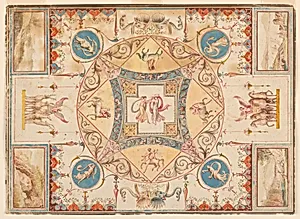
Ceiling in Hadrian's Villa, with Nymphs, Centaurs, Stags, and Elephants
ca. 1785
Classification
interiors
Department
Smithsonian Collection
Museum
Smithsonian American Art Museum
Credit
Museum purchase through gift of various donors and from Eleanor G. Hewitt Fund
Accession Number
1938-88-4830
Rights
Public Domain
About this artwork
Research in Progress
Art Historical Context
Step into the enchanting world of ancient Rome through this captivating 18th Italian artwork, *Ceiling in Hadrian Villa, with Nymph, Centaurs, Stags, and Elephants Created around 1785 by an unknown artist, it vividly recreates the opulent interior ceiling of Emperor Hadrian's grand villa in Tivoli,—a sprawling complex built in the 2nd century AD as a retreat blending architecture, gardens, and mythology. The composition bursts with dynamic figures: graceful nymphs, mythical centaurs, majestic stags, and exotic elephants, evoking the emperor's fascination with classical lore and distant lands. This piece reflects the Neoclassical fervor of the late 1700s, when European artists and travelers on the Grand Tour flocked to sites like Hadrian's Villa for inspiration. By capturing its fantastical ceiling—likely inspired by surviving Roman frescoes—it bridges antiquity and the Enlightenment, celebrating themes of nature, fantasy, and imperial grandeur. Classified as an interior in the Smithsonian American Art Museum's collection (acquired through donor gifts and the Eleanor G. Hewitt Fund), it invites us to ponder how 18th-century Italians revived ancient splendor amid their own cultural renaissance. Though research continues, this work's allure lies in its timeless blend of myth and history, reminding visitors of art's power to transport us across centuries.