
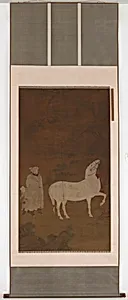
Central Asian groom pasturing a horse
14th century
Classification
Painting
Department
Smithsonian Collection
Museum
Smithsonian American Art Museum
Credit
Gift of Ruth Meyer Epstein
Accession Number
F1992.40
Rights
Public Domain
Tags
About this artwork
A turbaned Central Asian groom intensely watches over a white horse tied to a tree. The red tassel hanging from the bridle and the red string on the tail indicate the horse's high value and the likelihood that it was intended to be a gift to the throne. Such a theme-a foreign groom and a tribute horse waiting for imperial presentation-suggests that the original composition may have been created when China was under Mongol rule during the Yuan dynasty (1279-1368) and contacts with Central Asia we...
Art Historical Context
This intriguing painting, *Central Asian groom pasturing a horse*, captures a quiet yet meaningful moment from China's rich history of cultural exchange. A turbaned groom watches intently over a prized white horse tied to a tree, its red tassel and tail string signaling its high as a potential tribute for the imperial throne. Created by an unknown artist, the work likely dates to the Ming dynasty (1368–1644), though its composition echoes earlier Yuan dynasty (1279–1368) originals produced under Mongol rule, when ties with Central Asia flourished. The scene highlights the vital horse trade that connected China with Central Asian regions, serving both economic and diplomatic purposes. Such images were often created in workshop settings and repeated across generations, reflecting the enduring importance of these animals in imperial ceremonies and daily life. Gifted to the Smithsonian American Art Museum by Ruth Meyer Epstein, this piece offers visitors a window into themes of tribute, status, and cross-cultural connection that shaped East Asian art for centuries.
About the Artist
Unknown
The artist designated as "Unknown" in our virtual museum's collection exemplifies a poignant chapter in art history: creators whose identities have faded into obscurity despite the enduring power of their work. With only one known artwork attributed to them in our holdings, this figure represents countless anonymous hands that shaped visual culture across centuries. Museums worldwide, including th...