
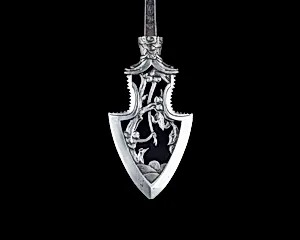
Ceremonial Arrowhead (<i>Yanone</i>)
dated 1645
Medium
Steel
Dimensions
L. 10 1/2 in. (26.7 cm); L. of head 3 7/8 in. (9.8 cm); W. 2 in. (5.1 cm); Wt. 3.5 oz. (99.2 g)
Classification
Archery Equipment-Arrowheads
Culture
Japanese
Department
Arms and Armor
Museum
Metropolitan Museum of Art, New York, NY
Credit
The Collection of Giovanni P. Morosini, presented by his daughter Giulia, 1932
Accession Number
32.75.406
Rights
Public Domain
Tags
Art Historical Context
This exquisite ceremonial arrowhead, known as a yanone, was crafted in 1645 by the renowned Japanese metalworker Umetada Motoshige. Fashioned from steel and measuring just under four inches in length, the piece exemplifies the refined artistry of early Edo-period Japan. While functional arrowheads served warriors in battle, yanone like this one were primarily created for display, ritual, or archery ceremonies, highlighting the cultural prestige of archery among the samurai class. Umetada Motoshige belonged to a distinguished lineage of swordsmiths and armorers whose work blended technical precision with decorative elegance. The arrowhead’s openwork design incorporates playful monkey motifs, a detail that adds symbolic depth—monkeys often represented cleverness and protection in Japanese folklore. Its balanced proportions and meticulous craftsmanship reflect the high standards of 17th-century metalworking, where even martial objects became vehicles for artistic expression. Housed in the Metropolitan Museum of Art’s Arms and Armor collection, this yanone offers visitors a glimpse into the intersection of warfare, ceremony, and aesthetics in Japanese culture. Its survival with a precise date underscores its historical value as both a functional artifact and a work of art.