
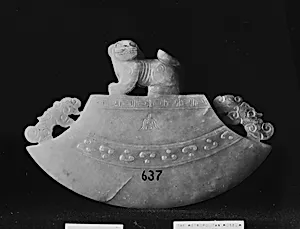
Ceremonial Axe
Unknown Artist
Medium
Nephrite, light sage green touched with russet pear leaf
Dimensions
H. 4 15/16 in. (12.6 cm); W. 3 7/16 in. (8.7 cm); D. 5/8 in. (1.6 cm)
Classification
Jade
Culture & Period
China · Qing dynasty (1644–1911), Qianlong period (1736–95)
Department
Asian Art
Museum
Metropolitan Museum of Art, New York, NY
Credit
Gift of Heber R. Bishop, 1902
Accession Number
02.18.637
Rights
Public Domain
Tags
Art Historical Context
This exquisite Ceremonial Axe, from nephrite jade in a light sage green touched with russet pear-leaf markings, hails from China's Qing dynasty during the Qianlong period (6–95). Measuring just under 5 inches tall, its compact form belies its grandeur as a ritual object, likely used in ceremonial or symbolic contexts rather than for practical warfare. The Metropolitan Museum of Art acquired it in 1902 as a gift fromber R. Bishop, their renowned Asian Art collection. In imperial China, jade—prized for its translucency, durability, and auspicious qualities—symbolized purity, immortality, and moral virtue. Nephrite, a tougher variety sourced from distant regions, was meticulously carved into forms like this axe, evoking ancient bronze prototypes from the Neolithic era while showcasing Qianlong-era mastery. Artisans employed fine grinding and polishing techniques to reveal the stone's natural veining, often incorporating animal motifs (as suggested by its tags) that imbued the piece with protective or cosmological significance. Qianlong Emperor's passion for jade elevated such works to imperial treasures, blending archaic reverence with refined elegance. Visitors, imagine holding this cool, tactile relic—a bridge to China's enduring jade tradition!