
Chalice Cover
Late 19th century
Medium
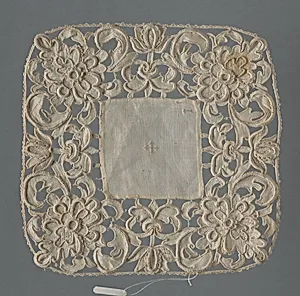
Linen, plain weave, embroidered in chain and cross stitches; edged with needle lace; with raised details in immitation of Venetian needle lace
Dimensions
17.6 × 17.2 cm (7 × 6 3/4 in.) Center square approx.: 2 3/4 × 2 3/4 in.
Classification
textile
Department
Textiles
Museum
Art Institute of Chicago
Accession Number
38922
Rights
Public Domain
Art Historical Context
This exquisite **Chalice Cover**, dating to the late 19 century, is a finely crafted liturgical textile from the Art Institute of Chicago Textiles Department. Measuring just 17.6 × 17.2 cm (7 × 6 3/4 in.), with a central embroidered square of about 2 3/4 × 2 3/4 in., it served to veil the chalice during Christian religious ceremonies, protecting its sacred contents and adding a layer of reverence to the Eucharist ritual. Produced by an unknown artisan, it reflects the era's devotion to elaborate needlework, blending utility with spiritual symbolism in Victorian-era ecclesiastical art. Crafted on a plain-weave linen ground, the cover showcases masterful embroidery in chain and cross stitches, which create textured motifs likely inspired by floral or sacred patterns. Its edges are adorned with delicate needle lace, while raised details cleverly imitate the intricate, airy Venetian needle lace (punto in aria) of the Renaissance—a prestigious technique known for its three-dimensional elegance and openwork filigree. This imitation highlights the artisan's technical virtuosity and the 19th-century revival of historical lace methods amid growing appreciation for fine crafts. As a testament to anonymous women's handiwork—often overlooked in art history—this piece underscores the cultural significance of textiles in religious life, preserving traditions of piety and precision that bridged medieval opulence with modern refinement. Visitors will appreciate its intimate scale and the tactile beauty of its stitches up close.
About the Artist
Unknown
The artist designated as "Unknown" in our virtual museum's collection exemplifies a poignant chapter in art history: creators whose identities have faded into obscurity despite the enduring power of their work. With only one known artwork attributed to them in our holdings, this figure represents countless anonymous hands that shaped visual culture across centuries. Museums worldwide, including th...