
Charles Brandon
March 26, 1798
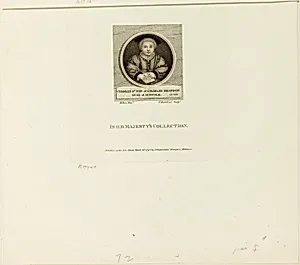
Medium
Stipple engraving on ivory wove paper
Dimensions
Image: 7.1 × 6.5 cm (2 13/16 × 2 9/16 in.); Plate: 17.4 × 15.3 cm (6 7/8 × 6 1/16 in.); Sheet: 27.1 × 28.3 cm (10 11/16 × 11 3/16 in.)
Classification
engraving
Department
Prints and Drawings
Museum
Art Institute of Chicago
Accession Number
154550
Rights
Public Domain
Art Historical Context
Visitors to the Art Institute of Chicago's Prints and Drawings department will encounter *Charles Brandon*, a delicate stipple engraving by Francescoolozzi, dated March26, 1798. This intimate portrait depicts Charles Brandon, the 1st Duke of Suffolk a prominent Tudor nobleman and close friend of King Henry VIII, for his dashing exploits and marriage to the king's sister, Mary Tudor. Bartolozzi, an influential Italian engraver who spent much of his career in England, masterfully reproduced such historical figures, bringing Renaissance-era nobility to 18th-century audiences. The artwork's medium—stipple engraving on ivory wove paper—highlights Bartolozzi's expertise in this technique, which uses fine dots rather than lines to build subtle tones, shadows, and textures. Popular in the late 18th century for its soft, painterly effects, stipple was ideal for portraits, mimicking the sfumato of oil paintings. The small image size (7.1 × 6.5 cm) within a larger plate and sheet underscores its role as an affordable print, making elite history accessible beyond oil canvases. This piece exemplifies the era's fascination with British heritage during the Romantic revival of Gothic and Tudor themes. Its precise dimensions and creamy paper preserve the engraving's luminous quality, inviting reflection on how prints democratized art and preserved legacies like Brandon's. A gem for print enthusiasts! (198 words)
About the Artist
Francesco Bartolozzi · 1727–1815
Francesco Bartolozzi (1727–1815) was an Italian engraver whose most productive period was spent in London, where he became the leading exponent of stipple engraving and a founding member of the Royal Academy. Born in Florence and trained first as a painter before turning to engraving in Venice, he established his reputation in Rome before being recruited by the English Royal Librarian Richard Dalt...