
Henry Brandon
March 26, 1798
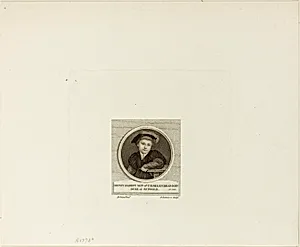
Medium
Stipple engraving on ivory wove paper
Dimensions
Image: 7.2 × 6.6 cm (2 7/8 × 2 5/8 in.); Plate: 15.2 × 16.6 cm (6 × 6 9/16 in.); Sheet: 23.1 × 28.3 cm (9 1/8 × 11 3/16 in.)
Classification
engraving
Department
Prints and Drawings
Museum
Art Institute of Chicago
Accession Number
154549
Rights
Public Domain
Art Historical Context
Step into the refined world of late 18th-century portraiture with *Henry Brandon*, a delicate stipple engraving created by Bartolozzi on March26, 1798. This intimate work, housed in the Art Institute of Chicago's Prints and Drawings, captures its subject on ivory wove paper—a smooth, high-quality stock ideal for fine reproductions. Measuring just 7.2 × 6.6 cm for the image itself, it exemplifies the miniaturist's art, designed for collectors' albums or personal display. Bartolozzi, a celebrated Italian engraver who flourished in England, mastered stipple technique, using tiny dots and flicks to build tonal gradations that mimic the softness of oil painting. This method revolutionized printmaking, allowing for nuanced shading and lifelike skin tones without harsh lines, making it perfect for fashionable portraits like this one. Popular in Georgian Britain, stipple engravings democratized access to elite likenesses, bridging art and commerce. As a snapshot of 1798 engraving prowess, *Henry Brandon* reflects the era's obsession with character studies amid revolutionary fervor across Europe. Its preservation highlights how such prints preserved identities and legacies for posterity—inviting us to ponder the enigmatic gaze of its namesake.
About the Artist
Francesco Bartolozzi · 1727–1815
Francesco Bartolozzi (1727–1815) was an Italian engraver whose most productive period was spent in London, where he became the leading exponent of stipple engraving and a founding member of the Royal Academy. Born in Florence and trained first as a painter before turning to engraving in Venice, he established his reputation in Rome before being recruited by the English Royal Librarian Richard Dalt...