
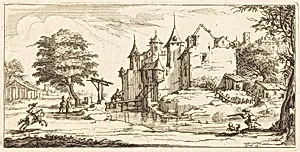
Chateau with a Drawbridge
1635 or after
Medium
etching on laid
Dimensions
plate: 8.2 × 16.6 cm (3 1/4 × 6 9/16 in.) sheet (irreg.): 10.5 × 20.2 cm (4 1/8 × 7 15/16 in.)
Classification
Department
CG-E
Museum
National Gallery of Art, Washington, D.C.
Credit
R.L. Baumfeld Collection
Accession Number
1969.15.137
Rights
Public Domain
Art Historical Context
"Chateau with a Drawbridge" is an etching created after Jacques Callot, the celebrated 17th-century French printmaker known for his precise and lively scenes of architecture, military life, and courtly events. Produced in 1635 or shortly thereafter—around the time of Callot’s death—this work reflects the enduring appeal of his designs, which were frequently copied and circulated by later artists. The etching technique, involving acid to bite fine lines into a metal plate, allowed for intricate details such as the texture of stone walls and the mechanics of the drawbridge, making the image both informative and visually engaging on a small scale. Measuring just 8.2 by 16.6 centimeters in the plate, the print exemplifies the intimate format typical of etchings meant for personal collections rather than large public display. Its subject—a fortified chateau—hints at the period’s fascination with defensive architecture amid ongoing European conflicts. Printed on laid paper, the sheet preserves the delicate tonal variations that give depth to the scene. Now part of the National Gallery of Art’s R.L. Baumfeld Collection, this work invites viewers to appreciate Callot’s lasting influence on printmaking and the way such images helped spread architectural and cultural ideas across 17th-century Europe.
About the Artist
after Jacques Callot
**Jacques Callot (c. 1592–1635)**, the master whose designs inspired the works attributed "after Jacques Callot," was a pioneering French Baroque printmaker and draftsman born in Nancy, capital of the independent Duchy of Lorraine (now northeastern France). From a noble family—his father served as master of ceremonies and herald-at-arms to the Duke of Lorraine—young Callot was apprenticed to a gol...