
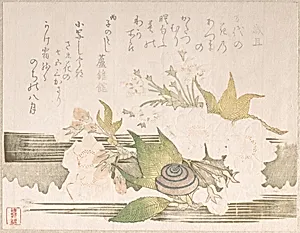
Cherry Blossoms and a Snail
Medium
Woodblock print (surimono); ink and color on paper
Dimensions
5 5/8 x 7 1/4 in. (14.3 x 18.4 cm)
Classification
Prints
Culture & Period
Japan · Edo period (1615–1868)
Department
Asian Art
Museum
Metropolitan Museum of Art, New York, NY
Credit
H. O. Havemeyer Collection, Bequest of Mrs. H. O. Havemeyer, 1929
Accession Number
JP2168
Rights
Public Domain
Tags
Art Historical Context
This delicate woodblock print, *Cherry Blossoms and Snail*, created by an unidentified artist in 1816 Japan's Edo period (16151868), captures a serene moment of nature's poetry. Measuring just 5 5/8 x 7 1/4 inches, its intimate scale invites close contemplation. Cherry blossoms, symbols of fleeting beauty in Japanese culture, flutter gracefully, evoking the hanami tradition of springtime appreciation. Juxtaposed with a humble snail, the composition blends ephemerality and persistence, a common motif in Edo-era art that reflects life's transience. As a *surimono*—a luxurious, privately commissioned woodblock print—the artwork showcases refined ukiyo-e techniques. Ink and color on paper achieve vibrant hues and subtle textures, often enhanced with mica or embossing for poetic New Year's greetings or celebrations among literati. Produced outside commercial markets, *surimono* like this one highlight the artistry of anonymous craftsmen, prioritizing elegance over mass appeal. Housed in the Metropolitan Museum of Art's Asian Art Department from the H. O. Havemeyer Collection, this piece offers a window into Edo Japan's refined aesthetic, where everyday wonders like flowers and snails inspired profound cultural reverence.