
Chessmen
Unknown Artist
late 18th century
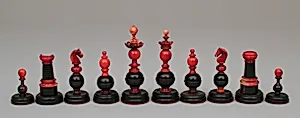
Medium
Ivory, ebonized boxwood
Dimensions
Height (each queen): 3 3/16 in. (8.1 cm); Height (each king): 3 1/2 in. (8.9 cm); Height (each bishop): 2 5/16 in. (5.9 cm); Height (each rook): 2 3/16 in. (5.6 cm); Height (each pawn): 1 9/16 in. (4 cm)
Classification
Chess Sets
Culture
Spanish or French
Department
European Sculpture and Decorative Arts
Museum
Metropolitan Museum of Art, New York, NY
Credit
Gift of Gustavus A. Pfeiffer, 1948
Accession Number
48.174.30a–p, aa–pp
Rights
Public Domain
Tags
Art Historical Context
Nestled in the Metropolitan Museum of Art's European Sculpture and Decorative collection, these "Chessmen" from the late 18th exemplify the elegance of period gaming artifacts. Crafted from ivory and ebonized box, the set features precisely scaled pieces: queens standing at 3 3/16 inches (8.1 cm), kings at 3 1/2 inches (8.9 cm), bishops at 2 5/16 inches (5.9 cm), rooks at2 3/16 inches (5.6 cm), and pawns at a modest 1 9/16 inches (4 cm). Likely of Spanish or French origin, gift from Gustavus A. Pfeiffer in 1948 highlights the craftsmanship of anonymous artisans who turned luxury materials into functional art. Chess flourished in 18th-century Europe as both a noble pastime and intellectual pursuit, often commissioning sets that blended utility with opulence. Ivory, prized for its smooth carvability and creamy sheen, formed the "white" pieces, while ebonized boxwood—stained dark for contrast—created the opposing side, mimicking ebony's richness at lower cost. These materials underscore the set's status as a gentleman's accessory, reflecting social hierarchies mirrored in the pieces' graduated heights. Though the artist remains unknown, the chessmen's refined proportions and material interplay reveal sophisticated turning and carving techniques typical of decorative arts workshops. A delightful window into Enlightenment-era leisure, they invite visitors to ponder the strategic minds that once maneuvered them across checkered boards.