
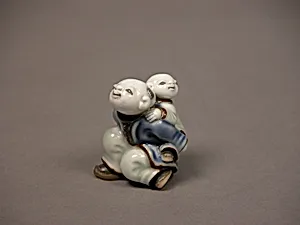
染付子運び唐子形根付|Child Carrying an Infant Netsuke
Unknown Artist
late 18th century
Medium
Porcelain with underglaze blue and overglaze enamels (Hirado ware)
Dimensions
H. 1 3/8 in. (3.5 cm); W. 1 in. (2.5 cm)
Classification
Ceramics
Culture & Period
Japan · Edo period (1615–1868)
Department
Asian Art
Museum
Metropolitan Museum of Art, New York, NY
Credit
Gift of Mrs. V. Everit Macy, 1923
Accession Number
23.225.81
Rights
Public Domain
Tags
Art Historical Context
This delightful netsuke, titled *Child Carrying an Infant*, captures a tender moment from everyday Japanese life during the late 18th century Edo period (1615–1868). Crafted as a small toggle for securing pouches to kimono sashes—before pockets were common—these miniature sculptures blended functionality with artistry. At just 1 3/8 inches tall, this piece exemplifies the intricate craftsmanship of Hirado ware, a prized porcelain from the Hirado kilns in Nagasaki, renowned for its fine, ivory-like white body that rivaled ivory carvings. The artwork showcases sophisticated techniques: underglaze blue (sometsuke) for the bold outlines and patterns, layered with vibrant overglaze enamels for colorful details on the child's and infant's robes. This combination allowed for vivid, durable decoration fired at high temperatures, highlighting the technical prowess of anonymous Edo artisans who elevated netsuke from utilitarian objects to collectible treasures. Culturally, the playful depiction of a child carrying a baby reflects Edo Japan's appreciation for family bonds and youthful innocence, often infused with whimsy in netsuke designs. Donated to the Metropolitan Museum of Art in 1923, it invites visitors to marvel at how such tiny ceramics encapsulated the era's refined aesthetic and social values.