
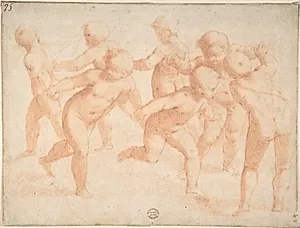
Children Dancing
16th century
Medium
Red chalk
Dimensions
8-1/8 x 10-3/4 in. (20.6 x 27.3 cm)
Classification
Drawings
Department
Drawings and Prints
Museum
Metropolitan Museum of Art, New York, NY
Credit
Gift of Cornelius Vanderbilt, 1880
Accession Number
80.3.232
Rights
Public Domain
Tags
Art Historical Context
In the lively "Children Dancing," an anonymous Italian artist from the 16th captures the joyful energy of youth through a delicate red chalk drawing. Measuring just 8-1/8 x 10-3/4 inches, this intimate sheet depicts children in motion, their forms twisting and leaping in a spontaneous dance. Red chalk, a favored medium in Renaissance Italy, allowed for subtle tonal modeling and fluid lines, making it ideal for life studies that emphasized natural movement over rigid poses. Created during the height of the Italian Renaissance, when artists like Leonardo da Vinci championed detailed observation of the human figure, this work reflects the era's fascination with anatomy, emotion, and everyday scenes. Though anonymous—possibly from a workshop or student sketch—it embodies the preparatory spirit of *disegno*, the foundational drawing practice central to Italian art. Dancing children evoke festive traditions, perhaps carnival revels or rural games, offering a rare glimpse into the innocence and vitality of Renaissance childhood. Today, this charming piece resides in the Metropolitan Museum of Art's Drawings and Prints department, a gift from Cornelius Vanderbilt in 1880. It invites visitors to appreciate the timeless delight in simple pleasures, preserved in chalk's warm sanguine hue.