
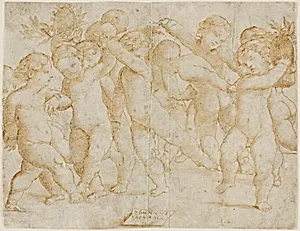
Twelve Children Dancing
Medium
Pen and brown ink with traces of black chalk on cream laid paper
Dimensions
9.6 × 12.5 cm (3 13/16 × 4 15/16 in.)
Classification
Department
Prints and Drawings
Museum
Art Institute of Chicago
Accession Number
4270
Rights
Public Domain
Art Historical Context
Domenico Campagnola's *Twelve Children Dancing* (1517) is a charming Renaissance drawing that captures the exuberant energy of youth. Rendered in pen and brown ink with subtle traces of black chalk on cream laid paper, this intimate work measures just 9.6 × 12.5 cm, inviting close contemplation. The twelve figures twist and leap in a lively circle, evoking the playful innocence and rhythmic vitality often celebrated in Venetian art of the early 16th century. Campagnola, a skilled draftsman from the Venetian school and influenced by masters like Titian, excelled in intricate line work that conveys movement and form with remarkable fluidity. The use of brown ink over faint chalk underdrawing reveals his preparatory precision, a technique prized in the Renaissance for studies that bridged drawing and printmaking. Classified as a print in the Art Institute of Chicago's Prints and Drawings department, it exemplifies the era's fusion of spontaneity and refinement. This gem highlights the cultural delight in childhood frolic during a time of humanistic revival, offering visitors a window into the joy and technical mastery of High Renaissance Venice. A perfect pause for appreciating art's whimsical side!
About the Artist
Domenico Campagnola · 1500–1564
Domenico Campagnola (c. 1500–1564), a Venetian Renaissance painter, engraver, and pioneering draftsman, was born around 1500, likely in Venice to German parents, and became a child prodigy under the tutelage of his adoptive father, Giulio Campagnola. Apprenticed to Giulio around 1507 in Venice, he mastered painting, drawing, engraving, and woodcutting from the esteemed Paduan engraver, whose stipp...