
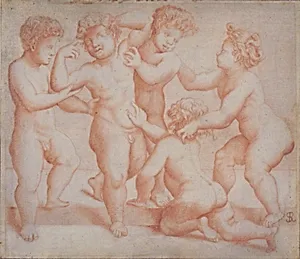
Frieze of Five Putti
1515–27
Medium
Red chalk on parchment
Dimensions
5 3/8 x 6 5/16in. (13.7 x 16cm)
Classification
Drawings
Department
Drawings and Prints
Museum
Metropolitan Museum of Art, New York, NY
Credit
Gift of Mr. and Mrs. Harry Brandt, 1959
Accession Number
59.79.4
Rights
Public Domain
Tags
Art Historical Context
In the bustling workshops of early 16th-century Rome, Marco Dente (c. 1485–1527), a engraver and pupil ofantonio Raimondi, this enchanting *Frieze of Five Put* between 1515 and1527. Rendered in vibrant red chalk on parchment—a durable, creamy favored for detailed studies—this compact drawing (5 3/8 x 6 5/16 in.) captures a playful procession of five winged cherubs, or *putti*, tumbling and gesturing in rhythmic harmony. These chubby, joyful boys were Renaissance staples, symbolizing love, innocence, and divine playfulness, often adorning friezes in grand palaces and religious art inspired by classical antiquity. Dente's fluid lines and subtle shading showcase High Renaissance mastery, blending Raphael's grace with emerging Mannerist elegance. Red chalk allowed for soft modeling and warm tones, making this likely a *modello*—a preparatory design for engravings or frescoes, fields where Dente excelled. Its frieze format evokes ancient Roman reliefs revived during the Renaissance, bridging pagan motifs with Christian iconography. Generously gifted to the Metropolitan Museum of Art in 1959 by Mr. and Mrs. Harry Brandt, this delicate sheet invites visitors to marvel at the intimate artistry behind monumental works. A window into Dente's world, it reminds us how Renaissance draftsmen turned whimsy into enduring beauty.
About the Artist
Marco Dente · 1515–1527
Marco Dente (died 1527), also known as Marco da Ravenna, was among the most accomplished printmakers working in Rome during the High Renaissance, a period that witnessed an extraordinary flowering of engraving as both a reproductive and an independent artistic medium. Little is known of his early training, but by the second decade of the sixteenth century he had established himself in the orbit of...