
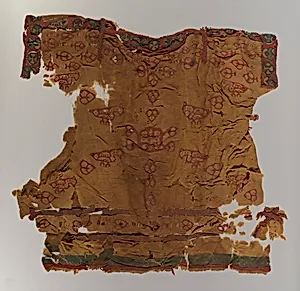
Child's Tunic
Roman period (30 BCE–641 CE)-Arab period (641–969), 7th century
Medium
Linen and wool, tapestry weave
Dimensions
48.3 × 47 cm (19 × 18 1/2 in.)
Classification
textile
Department
Textiles
Museum
Art Institute of Chicago
Accession Number
70430
Rights
Public Domain
About this artwork
This small garment would have fit an infant, likely no more than one year old. It is one of numerous textiles that covered the child for burial; fragments of other pieces remain attached to the inside of the tunic. Burial clothing was usually worn in life, so this would have already been a well-worn garment when the child was laid to rest. Many small garments for children survive today because of the high infant mortality rate during this time in Egypt.
About the Artist
Coptic
Coptic, the collective attribution for anonymous masters of early Christian Egypt, embodies the vibrant fusion of pharaonic, Hellenistic, and Greco-Roman traditions that defined art from the 4th century onward. Emerging in the context of Coptic Christianity's rise after the 1st century AD, these artists operated amid economic constraints that favored functional craftsmanship over elite patronage, ...