
Doll's Tunic
Unknown Artist
6th–8th century
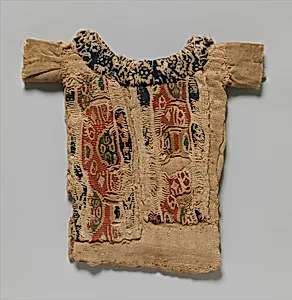
Medium
Wool, linen; plain weave, tapestry weave
Dimensions
Max. H. 6 5/8 in. (16.8 cm) Max. W. 6 7/8 in. (17.5 cm)
Classification
Textiles
Department
Islamic Art
Museum
Metropolitan Museum of Art, New York, NY
Credit
Gift of George F. Baker, 1890
Accession Number
90.5.627
Rights
Public Domain
Art Historical Context
This delicate *Doll's Tunic*, crafted by an unknown artist between the6th and 8th centuries, offers a charming glimpse into early Islamic textile traditions. Measuring just 6 5/8 by 6 7/8 inches, this tiny wool and linen garment was likely designed for a doll, reflecting everyday life and play in the burgeoning Islamic world during the Umayyad era. As part of the Metropolitan Museum of Art's Islamic Art collection—generously gifted by George F. Baker in1890—it survives as a rare example of miniature clothing from a time when textiles were central to cultural expression. The tunic showcases sophisticated weaving techniques: a plain weave for the sturdy linen base provided durability, while tapestry weave in wool added colorful, pictorial details typical of early Islamic fabrics. These methods highlight the skill of artisans who wove intricate patterns without modern looms, often incorporating geometric motifs or symbolic imagery suited to small-scale objects. Such doll attire suggests dolls were used in households for children's amusement or perhaps ritual purposes, underscoring the blend of utility and artistry in pre-modern societies. Today, this artifact invites us to marvel at the precision of ancient hands, preserving a thread of history from over 1,300 years ago.