
Chinese Junks Sampans, Shanghai River
1865
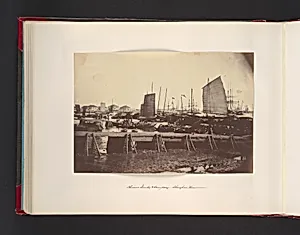
Medium
Albumen silver print from glass negative
Dimensions
21.3 × 31.6 cm (8 3/8 × 12 7/16 in.)
Classification
Photographs
Department
Photographs
Museum
Metropolitan Museum of Art, New York, NY
Credit
Gilman Collection, Purchase, Cynthia Hazen Polsky Gift, 2005
Accession Number
2005.100.583 (91b)
Rights
Public Domain
Art Historical Context
In 1865, Scottish photographer John Thomson captured *Chinese Junks Sampans, Shanghai River*, a vivid albumen silver print that offers a window into mid-19th-century China during the height of Western trade influence. Shanghai, a bustling treaty port following the Opium Wars, teemed with traditional junks—sturdy sailing vessels with distinctive curved sails—and nimble sampans ferrying goods and people along the Huangpu River. Thomson, a pioneering photojournalist known for his ethnographic work in Asia, documented everyday scenes like this with remarkable clarity, later publishing them in his seminal book *Illustrations of China and Its People* (1873–74). The medium, an albumen silver print made from a glass negative, was the gold standard of 19th-century photography. Egg whites (albumen) coated the paper, yielding sharp details, warm tones, and a subtle gloss that brought the river's activity to life on this 21.3 × 31.6 cm sheet. This technique allowed Thomson to freeze fleeting moments of cultural vibrancy, blending artistry with documentary precision. Today, housed in The Metropolitan Museum of Art's Gilman Collection, this photograph highlights the intersection of East and West, preserving a vanishing maritime world amid rapid modernization. It's a testament to photography's power to bridge cultures and time.
About the Artist
John Thomson · 1837–1921
John Thomson (1837–1921), a pioneering Scottish photographer, was born on 14 June 1837 in Edinburgh as the eighth of nine children to William Thomson, a tobacco spinner and trader, and Isabella Newlands.) After schooling in the early 1850s, he apprenticed with a local optical and scientific instrument manufacturer, where he mastered the principles of photography, completing his training around 185...