
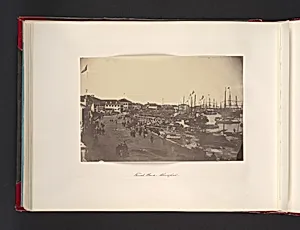
French Bund, Shanghai
1865
Medium
Albumen silver print from glass negative
Dimensions
18.7 × 29.2 cm (7 3/8 × 11 1/2 in.)
Classification
Photographs
Department
Photographs
Museum
Metropolitan Museum of Art, New York, NY
Credit
Gilman Collection, Purchase, Cynthia Hazen Polsky Gift, 2005
Accession Number
2005.100.583 (90b)
Rights
Public Domain
Art Historical Context
In 1865, Scottish photographer John Thomson captured the *French Bund, Shanghai* an albumen silver print a glass negative, offering a rare glimpse into one of China's most dynamic treaty ports during the mid-19th century. image depicts the Huangpu River waterfront in Shanghai's French Concession, a vibrant hub of colonial trade and architecture where European-style buildings rose amid traditional Chinese life. Thomson, a pioneering traveler-photographer who documented Asia extensively from the 0s, arrived in Hong Kong around 1862 and ventured into mainland China, recording the era's cultural intersections with remarkable clarity. This 18.7 × 29.2 cm photograph exemplifies early wet-collodion techniques: Thomson coated glass plates with collodion on-site, exposed them while still wet, and developed prints using light-sensitive albumen (egg white) paper for warm, detailed tones and sharp contrasts. Such prints were prized for their archival quality and ability to convey expansive cityscapes, making this work a vital historical document of Shanghai's transformation from fishing village to global metropolis under Western influence. Housed in The Metropolitan Museum of Art's Gilman Collection, *French Bund, Shanghai* highlights photography's role in bridging East and West, inviting viewers to ponder the legacies of imperialism amid the river's timeless flow.
About the Artist
John Thomson · 1837–1921
John Thomson (1837–1921), a pioneering Scottish photographer, was born on 14 June 1837 in Edinburgh as the eighth of nine children to William Thomson, a tobacco spinner and trader, and Isabella Newlands.) After schooling in the early 1850s, he apprenticed with a local optical and scientific instrument manufacturer, where he mastered the principles of photography, completing his training around 185...