
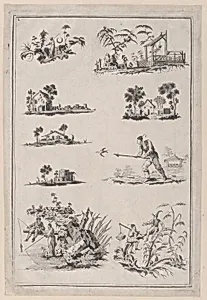
Chinoiserie Ornaments
ca. 1760–85
Medium
Etching
Dimensions
Sheet (Trimmed): 11 13/16 × 7 7/8 in. (30 × 20 cm) Plate: 11 7/16 × 7 3/8 in. (29 × 18.8 cm)
Classification
Prints|Ornament & Architecture
Department
Drawings and Prints
Museum
Metropolitan Museum of Art, New York, NY
Credit
Rogers Fund, 1921
Accession Number
21.91.250
Rights
Public Domain
Tags
Art Historical Context
Jean Pillement’s *Chinoiserie Ornaments*, created around 1760–85, captures the playful European fascination with imagined Asian landscapes during the height of the Rococo era. As an etching on paper, the work belongs to a category of ornamental prints designed for practical use by craftsmen, decorators, and manufacturers. These sheets often served as models for textiles, wallpapers, ceramics, and furniture, allowing the delicate, exotic motifs to circulate widely across Europe. Pillement, a French artist celebrated for his lighthearted chinoiserie designs, populates the scene with fanciful pavilions, winding paths, and figures engaged in leisurely pursuits such as fishing. The medium of etching allowed him to render fine, scrolling lines and intricate details that evoke both Chinese landscape painting and European fantasy. Acquired by the Metropolitan Museum through the Rogers Fund in 1921, this print exemplifies how eighteenth-century artists blended cultural curiosity with decorative elegance, transforming distant inspirations into accessible, whimsical ornament.
About the Artist
Jean Pillement · 1728–1808
**Jean-Baptiste Pillement (also known as Jean Pillement)** was a French painter, designer, and engraver born on 24 May 1728 in Lyon, where he also died on 26 April 1808. He became one of the most influential decorative artists of the Rococo period, celebrated for his delicate landscapes and exotic chinoiserie designs that spread across Europe through prints and decorative applications. Pillement ...