
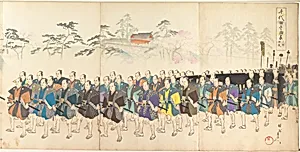
Chiyoda Castle (Album of Men)
Medium
Hexaptych of woodblock prints; ink and color on paper
Dimensions
L. (page) 13 7/8 in. (35.2 cm); W. (page) 9 1/4 in. (23.4 cm); thickness of album 1 9/16 in. (4 cm)
Classification
Prints
Culture & Period
Japan · Meiji period (1868–1912)
Department
Asian Art
Museum
Metropolitan Museum of Art, New York, NY
Credit
Gift of Mrs. W. Walton Butterworth, 1979
Accession Number
JP3561
Rights
Public Domain
Tags
Art Historical Context
This striking hexaptych from 1897 captures a lively gathering of men at Chiyoda Castle, the historic seat of the Tokugawa shoguns and symbol of Japan’s feudal past. Created by Yōshū Chikanobu during the Meiji period, the album presents the scene across six woodblock-printed panels, allowing viewers to appreciate both the individual figures and the bustling crowd as a whole. Men in traditional attire, many carrying swords, fill the composition, evoking the final decades before the samurai class was officially dissolved. Chikanobu, a leading ukiyo-e artist of his time, specialized in historical and genre scenes that appealed to audiences navigating rapid modernization. Woodblock printing, long celebrated for its vibrant colors and precise line work, remained popular in the Meiji era even as photography emerged. Here, the medium’s ability to reproduce detailed group compositions made it ideal for documenting or romanticizing castle life. Housed in album format, the work invites intimate viewing, reflecting both private appreciation and public nostalgia for Japan’s pre-modern heritage. Its presence in the Metropolitan Museum’s collection highlights the enduring global interest in Meiji-period prints as bridges between tradition and modernity.
About the Artist
Yōshū (Hashimoto) Chikanobu · 1838–1912
Toyohara Chikanobu, born Hashimoto Naoyoshi in 1838 in Echigo Province (modern Niigata Prefecture), emerged as one of the last great ukiyo-e masters during Japan's Meiji era. The son of a low-ranking samurai retainer to the Sakakibara clan, he trained initially in the Kanō school of painting before turning to ukiyo-e printmaking. He studied under a disciple of Keisai Eisen, then joined the studio ...