
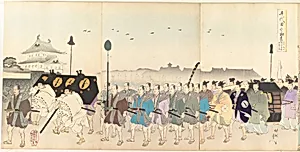
Chiyoda Castle (Album of Men)
Medium
Triptych of woodblock prints; ink and color on paper
Dimensions
L. (page) 13 7/8 in. (35.2 cm); W. (page) 9 1/4 in. (23.4 cm); thickness of album 1 9/16 in. (4 cm)
Classification
Prints
Culture & Period
Japan · Meiji period (1868–1912)
Department
Asian Art
Museum
Metropolitan Museum of Art, New York, NY
Credit
Gift of Mrs. W. Walton Butterworth, 1979
Accession Number
JP3565
Rights
Public Domain
Tags
Art Historical Context
Step into the vibrant world of Meiji-era with *Chiyoda Castle ( of Men)*, a stunning triptych woodblock print Yōshū (Hashimoto) Chikan, created in 1897. Chikanobu, a master of ukiyo-e—the "pictures of the floating world"—captured the energy of Tokyo's historic Chiyoda Castle (formerly Edo Castle) amid Japan's rapid modernization during the Meiji period (8–1912). This album page, measuring about 14 by 9 inches, showcases ink and on paper, folded into a compact 1.5-inch-thick volume, perfect for intimate viewing. The scene buzzes with life: a crowd of men, some wielding swords, gathered amid houses near the castle's imposing walls. Tags like "Houses|Swords|Men|Crowd" hint at a dynamic gathering, perhaps evoking samurai traditions or everyday Edo vitality on the cusp of change. Chikanobu's precise woodblock technique—carving multiple blocks for layered colors and fine details—brings the figures to vivid life, blending historical nostalgia with contemporary flair. Housed in the Metropolitan Museum of Art's Asian Art Department since 1979, this print reflects ukiyo-e's cultural role in preserving Japan's warrior heritage during a time of Western influence. A delightful window into Meiji masculinity and urban bustle, it invites you to ponder the clash of old and new. (198 words)
About the Artist
Yōshū (Hashimoto) Chikanobu · 1838–1912
Toyohara Chikanobu, born Hashimoto Naoyoshi in 1838 in Echigo Province (modern Niigata Prefecture), emerged as one of the last great ukiyo-e masters during Japan's Meiji era. The son of a low-ranking samurai retainer to the Sakakibara clan, he trained initially in the Kanō school of painting before turning to ukiyo-e printmaking. He studied under a disciple of Keisai Eisen, then joined the studio ...