
Chiyoda Castle (Album of Men)
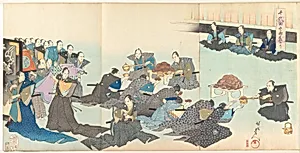
Medium
Triptych of woodblock prints; ink and color on paper
Dimensions
L. (page) 13 7/8 in. (35.2 cm); W. (page) 9 1/4 in. (23.4 cm); thickness of album 1 9/16 in. (4 cm)
Classification
Prints
Culture & Period
Japan · Meiji period (1868–1912)
Department
Asian Art
Museum
Metropolitan Museum of Art, New York, NY
Credit
Gift of Mrs. W. Walton Butterworth, 1979
Accession Number
JP3573
Rights
Public Domain
Tags
Art Historical Context
Created by the renowned ukiyo-e artist Yōshū Chikanobu in 1897, this triptych of woodblock prints captures scenes from Chiyoda Castle—better known as Edo Castle—during Japan’s Meiji period. Chikanobu, celebrated for his vibrant depictions of historical and contemporary life, often looked back to the Tokugawa era with a nostalgic eye even as Japan rapidly modernized. The album format allowed viewers to experience a sequence of intimate moments, here focused on groups of men gathered around food. Printed in ink and color on paper, the work exemplifies the refined techniques of late nineteenth-century Japanese printmaking, where delicate lines and layered pigments brought everyday rituals to life. The triptych composition expands the narrative across three panels, inviting the eye to follow the shared meal and lively interactions. Such prints served not only as art but also as popular keepsakes that preserved cultural memory for a changing society. Today housed in the Metropolitan Museum of Art’s Asian Art collection, this piece offers a warm glimpse into Meiji-era reflections on Japan’s feudal past.
About the Artist
Yōshū (Hashimoto) Chikanobu · 1838–1912
Toyohara Chikanobu, born Hashimoto Naoyoshi in 1838 in Echigo Province (modern Niigata Prefecture), emerged as one of the last great ukiyo-e masters during Japan's Meiji era. The son of a low-ranking samurai retainer to the Sakakibara clan, he trained initially in the Kanō school of painting before turning to ukiyo-e printmaking. He studied under a disciple of Keisai Eisen, then joined the studio ...