
Chiyoda Castle (Album of Men)
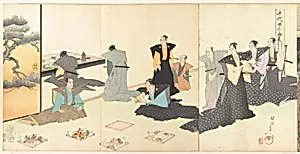
Medium
Triptych of woodblock prints; ink and color on paper
Dimensions
L. (page) 13 7/8 in. (35.2 cm); W. (page) 9 1/4 in. (23.4 cm); thickness of album 1 9/16 in. (4 cm)
Classification
Prints
Culture & Period
Japan · Meiji period (1868–1912)
Department
Asian Art
Museum
Metropolitan Museum of Art, New York, NY
Credit
Gift of Mrs. W. Walton Butterworth, 1979
Accession Number
JP3580
Rights
Public Domain
Tags
Art Historical Context
Created in 1897 during Japan’s Meiji period, *Chiyoda Castle (Album of Men)* by Yōshū Chikanobu captures a moment of quiet vigilance within the historic grounds of Edo Castle, the former seat of the Tokugawa shoguns. Chikanobu, a leading ukiyo-e artist of his time, specialized in historical and genre scenes that appealed to viewers nostalgic for the samurai past even as Japan rapidly modernized. This triptych format—three woodblock prints joined to form a single wide composition—allows the artist to present a sweeping view of men in traditional attire gathered beneath ancient trees, their weapons suggesting both martial readiness and ceremonial display. Woodblock printing, long central to Japanese visual culture, enabled artists like Chikanobu to combine bold line work with delicate color gradations, producing affordable yet visually rich images for a broad audience. Here the medium highlights the contrast between the lush greenery of the castle gardens and the crisp details of armor and swords, evoking the disciplined harmony once maintained within Chiyoda’s walls. Acquired by the Metropolitan Museum as a gift in 1979, the album page offers today’s visitors a vivid glimpse into Meiji-era reflections on Japan’s feudal heritage.
About the Artist
Yōshū (Hashimoto) Chikanobu · 1838–1912
Toyohara Chikanobu, born Hashimoto Naoyoshi in 1838 in Echigo Province (modern Niigata Prefecture), emerged as one of the last great ukiyo-e masters during Japan's Meiji era. The son of a low-ranking samurai retainer to the Sakakibara clan, he trained initially in the Kanō school of painting before turning to ukiyo-e printmaking. He studied under a disciple of Keisai Eisen, then joined the studio ...