
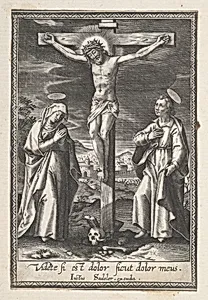
Christ on the Cross
1578–ca. 1620
Medium
Engraving
Dimensions
Sheet: 3 7/16 × 2 5/16 in. (8.7 × 5.9 cm)
Classification
Prints
Department
Drawings and Prints
Museum
Metropolitan Museum of Art, New York, NY
Credit
Harris Brisbane Dick Fund, 1953
Accession Number
53.601.12(61)
Rights
Public Domain
Tags
Art Historical Context
This poignant engraving, *Christ on the Cross*, attributed to the Flemish artist Justus Sadeler or an anonymous follower, dates from around 1578 to 1620. Measuring just 3 7/16 × 2 5/16 inches, its intimate scale made it ideal for personal devotion, slipping easily into a prayer book or pocket during the late Renaissance. The scene captures the Crucifixion, with Christ on the cross flanked by figures including men and women—likely the Virgin Mary and saints—evoking profound religious emotion in a compact composition. Engravings like this were revolutionary printmaking techniques of the Northern Renaissance, using a burin to incise fine lines into a metal plate, inked and pressed onto paper for precise, reproducible images. Justus Sadeler, part of Antwerp's renowned Sadeler family of engravers, specialized in such devotional works, often reproducing paintings by masters like Albrecht Dürer or Raphael. Amid the Counter-Reformation, these affordable prints spread Catholic iconography across Europe, fostering private piety amid religious upheaval. Today, housed in the Metropolitan Museum of Art's Drawings and Prints department (Harris Brisbane Dick Fund, 1953), this piece exemplifies how art democratized faith, bridging grand altarpieces with everyday spirituality. Visitors will appreciate its meticulous detail, a testament to the era's technical mastery and spiritual fervor.
About the Artist
Anonymous|Justus Sadeler
In the vast tapestry of art history, "Anonymous" stands not as a singular individual but as a collective designation for countless unidentified creators whose works have endured across millennia. These artists, spanning prehistoric cave painters to medieval illuminators and folk craftsmen, produced the foundational layers of human visual culture. Prior to the Renaissance, when individual fame emer...