
Christus in Emmaüs
1455 - 1503
Medium
engraving
Dimensions
209; 145
Rights
Public Domain
About this artwork
gravure
Art Historical Context
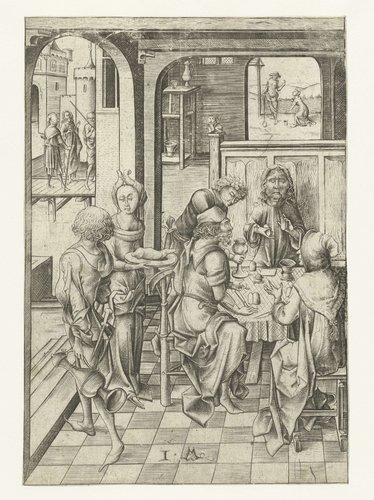
**Christus in Emmaüs** is a striking engraving by Israhel van Meckenem, a prominent German printmaker active between 1455 and 1503. This work captures the biblical Road to Emmaus scene from Luke's Gospel, where the resurrected Christ reveals himself to two disciples during a meal. Measuring 209 mm high by 145 mm wide, the intimate scale invites close viewing, revealing van Meckenem's mastery of fine detail in a medium that revolutionized art dissemination in the late 15th century. As a key figure in the Early Northern Renaissance, van Meckenem excelled in engraving—a technique where intricate lines are incised into a copper plate, inked, and pressed onto paper. His style features precise hatching for shading, expressive faces, and elaborate drapery, echoing influences from contemporaries like Martin Schongauer. Engravings like this were affordable multiples, making sacred imagery accessible beyond elite patrons and aiding lay devotion during a time of growing religious fervor. This piece exemplifies the Northern Renaissance's emphasis on narrative clarity and emotional depth in religious art, bridging Gothic traditions with emerging realism. Visitors will appreciate how van Meckenem's gravure (engraving) not only educates on scripture but also showcases the era's innovative print culture, paving the way for the print revolution.
About the Artist
Israhel van Meckenem · 1435–1503
Israhel van Meckenem (c. 1445–1503), also known as Israhel van Meckenem the Younger, was a pioneering German engraver and goldsmith based in Bocholt, near the Dutch border, renowned as the most prolific printmaker of the fifteenth century. Born into a family possibly of Dutch origin, he was the son of Israhel van Meckenem the Elder, a goldsmith who settled in Bocholt in 1457. He trained initially ...