
Ciprianis rudiments of drawing
1796-02-23
Medium
etching
Dimensions
220; 312
Rights
Public Domain
About this artwork
height 220 mm x width 312 mm
Art Historical Context
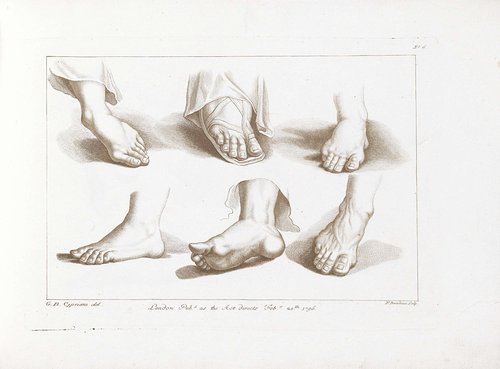
**Cipriani's Rudiments of** is a delicate etching by Francesco Bartolozzi, February 23, 1796. Measuring 220 mm height and 312 mm width, this print captures the elegance of late 18th-century instructional art. Bartolozzi, a renowned engraver who spent much of his career in (1764–1802), was for his mastery of the stipple technique—a dotted method that brought softness and tonal gradation to prints, making them ideal for reproducing drawings and paintings. Etching, the medium here, involves coating a metal plate with acid-resistant ground, scratching lines through it, and immersing it in acid to "bite" the grooves. This allowed precise, reproducible images perfect for educational purposes. Likely a frontispiece or illustrative plate for Giovanni Battista Cipriani's drawing manual, it reflects the Enlightenment-era enthusiasm for accessible art education, especially among amateurs in Georgian Britain. Bartolozzi's collaboration with Cipriani, a fellow Italian artist in London, highlights the vibrant expatriate creative scene. Such works democratized artistic skills, fostering a culture of drawing as a genteel accomplishment. Visitors will appreciate its refined lines and historical nod to printmaking's role in spreading knowledge.
About the Artist
Francesco Bartolozzi · 1727–1815
Francesco Bartolozzi (1727–1815) was an Italian engraver whose most productive period was spent in London, where he became the leading exponent of stipple engraving and a founding member of the Royal Academy. Born in Florence and trained first as a painter before turning to engraving in Venice, he established his reputation in Rome before being recruited by the English Royal Librarian Richard Dalt...